
How Procurement Teams Can Use Data as a Conversation Starter
Conor Allmond & Tony Howe
For this edition of The Pragmatist, we sat down with Tony Howe, Senior Systems and Data Manager at SmartTogether, and Conor Allmond, Senior Consultant at EcoVate Group. They spoke with Helen Lisle, Principal Consultant at EcoVate Group, about how procurement teams can turn data into decisions that get made and add value to the wider organisation.
The Importance of Context
We have all seen it happen. Someone produces a number that suits the case they are making and treats the matter as settled. Tempting as that may be, it is the wrong way to use data. A number without context can unravel the moment it is examined. A spend figure that looks like an obvious saving can look very different once the clinical reality behind it is understood.
Data is, of course, important, but it should be used to start a collaborative conversation rather than shut one down. Instead of arriving with an answer, arrive with a well-evidenced observation and ask: “Can we talk about what we think this means?”
This keeps procurement honest about the limits of what the data shows, and it treats the people on the other side of the table as partners rather than as recipients of a verdict. This is important. As one of our contributors put it, data tells you what happened; conversation is how you find out why.
An insight report therefore opens a discussion instead of closing one down. A clinician who might resist being told what they are doing wrong will often engage readily with an honest: “Here is what we are seeing; help us understand it.” Trends that look alarming in isolation frequently have perfectly good explanations. The way to discover them is through conversation.
Rubbish In, Rubbish Out
Even to open a conversation, and gain the respect of colleagues, the questions being asked need to be credible. And credibility comes from the quality of the data. The hard work needs to be done in advance.
This means doing the basics well. Consistent cost-centre and account-code mapping. Consistent naming conventions. Units of measure that are correct (which sounds trivial until a product bought in single units is recorded as a box of a hundred, ensuring every subsequent supply-chain report is wrong). Even the formatting of product codes matters, because finance and ordering systems that handle special characters differently will generate mismatches that then have to be untangled by hand. None of this is exciting. All of it is the difference between data people trust and data they argue about. Rubbish in, rubbish out.
Much of this can be improved systematically, rather than manually. One approach that worked well was to build reference and mapping sheets that gave the data platform the additional context it needed. This lifted the automatic match rate from around seventy per cent to well over ninety. Where systems and cataloguing are less mature, however, the practitioner’s experience becomes invaluable: stripping the data back to suppliers and categories, then mapping it manually from their own knowledge of the products and the market. This can work, but it is not ideal. The goal is for systems to do the mapping, so that teams work from clean data at a sensible level rather than rebuilding it from the ground up every time.
Agreeing What "Good Enough" Looks Like
One fact of life is that a gap will exist between different versions of the truth, most commonly between procurement’s purchase-order data and finance’s general-ledger position. Timing differences, part-receipted orders and payment terms mean the two rarely reconcile exactly. A report handed to a budget-holder can therefore trigger an unhelpful “we never spent that” before any useful discussion has begun.
Remember the goal is to facilitate trust and collaboration. The pragmatic approach skips the chase for perfect reconciliation and focuses instead on being scrupulously clear about what a given data set represents. One suggestion is to treat the moment a requisition becomes a purchase order as committed spend, regardless of when it is ultimately paid.
Whatever the chosen basis, the discipline is the same: state plainly what the data is, where it came from, what period it covers and what it does and does not include, and get everyone to accept it as a good-enough starting point. Chasing a penny here against a penny there is how you ensure the conversation never happens at all.
From a Headline Figure to a Real Opportunity
Consider a stock-management project we saw in a specialist Trust. Consignment stock, supplier-owned product held on site and paid for only once used, is common in areas such as orthopaedics, where clinicians need a wide range of sizes available but do not want to buy the whole range. It is also an area where visibility can break down: a Trust can end up holding more stock than the consignment arrangement assumes, uncertain what it owns, what it has already paid for and what it will owe once used.
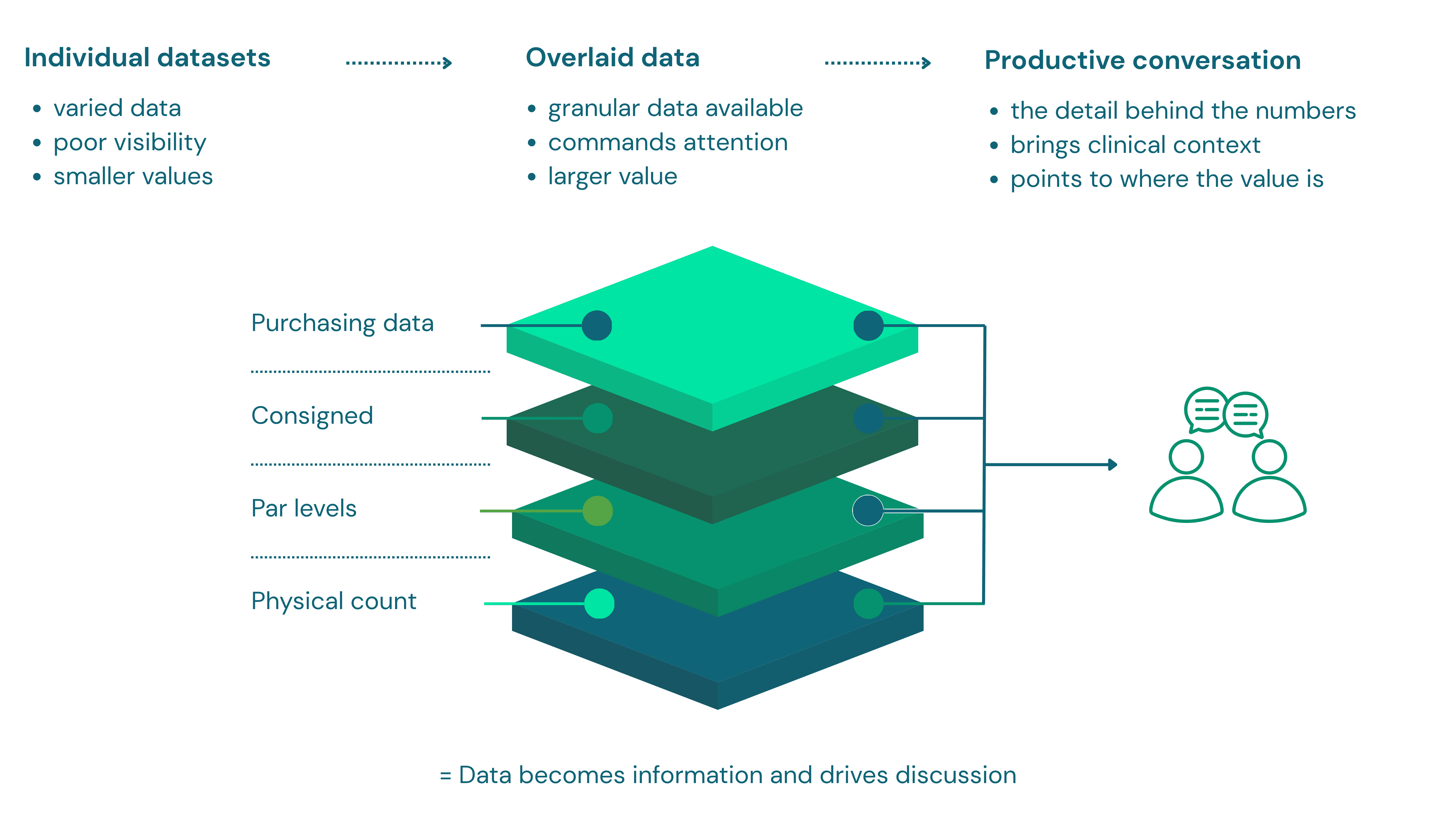
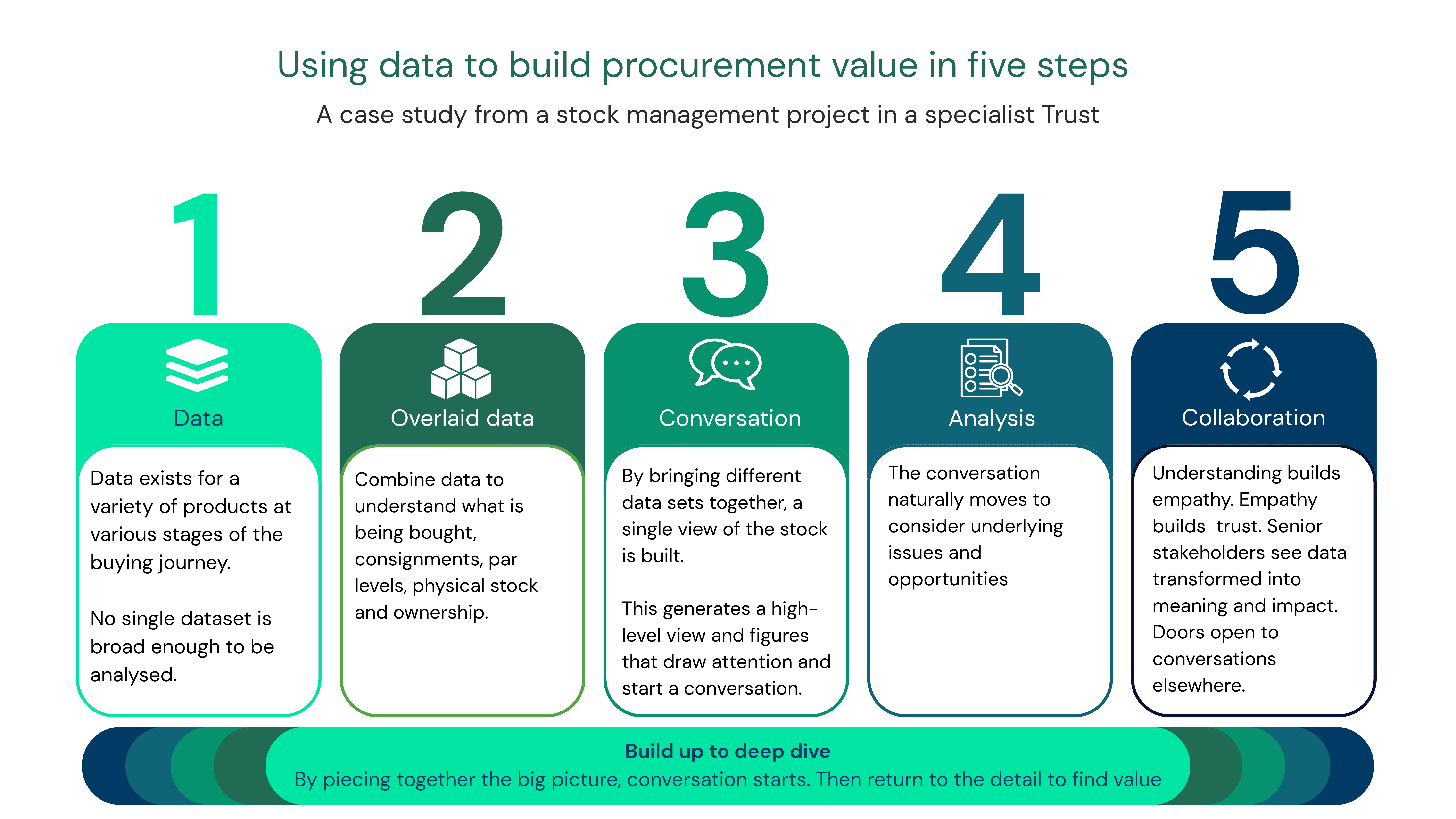
In this example, the approach was to overlay several data sets: what was being bought, what was recorded as consigned, what par levels applied and what was physically on the shelf. This generated a high-level figure large enough to command attention, backed by the granular detail needed to defend it.
This began a productive conversation. Attention shifted from the headline number to the underlying questions behind it: How had visibility been lost? What policies were missing? What needed to change to ensure better control in future?
You Do Not Have to Be the Expert in Everything
Being good with data is about coordination: collating finance information, stock-holding figures, supply-chain records and procurement data and assembling them into a coherent picture. The practitioner does not need to own every source but does need to understand what they are looking at and have the granular detail to evidence a high-level claim.
Temperament matters here as much as technical skill. What makes a good practitioner is curiosity, common sense and a genuine interest in the people and the organisation they work with. Front-line experience is also hugely helpful, because it helps practitioners understand the reality behind a dataset. That grounding is hard to fake and easy to undervalue.
What Good Data Makes Possible
With strong foundations, the range of conversations data can open widens considerably. Basic process statistics can be genuinely powerful: showing a team that they placed thousands of orders with a single supplier in a month, and that consolidating them would release real cash and cut administrative burden, will be more effective than any general appeal to efficiency.
Higher up, the same discipline supports benchmarking and aggregation, but only if the underlying data quality is there. The prize is significant. Rather than looking at spend at cost-centre level, which fragments an opportunity into pieces too small to bother with, you can step back and size it properly across a whole organisation, and then across several. A conversation about a couple of hundred thousand pounds in one directorate becomes a conversation about millions across a Trust, and potentially tens of millions across a wider system.
Data can also turn procurement’s attention forward, from reporting what already happened to forecasting what comes next. Finance functions are often good at reporting what has happened and less confident forecasting what will. By overlaying historic purchasing with clinical intelligence about service plans and case mix, procurement can help build a credible forward view, and, crucially, distinguish spend rising because of price from spend rising because of volume or a shift in the type of product used.
Categorising within a category - separating, say, the premium devices from the standard ones - and then benchmarking against comparable organisations can reveal that a peer treats a similar patient mix with a very different product mix. That does not tell a clinician how to treat a patient, but it does create an even playing field for a proper strategic conversation, and it can, at its best, influence product choice without anyone being instructed.
The same information sometimes points somewhere larger still. If a service keeps doing exactly what it has always done, there is a limit to what changing suppliers or prices can deliver. Data presented to senior stakeholders can be the starting point not just for a better deal but for service redesign, the recognition that how the work is done often matters as much as what is bought. Some would call that procurement straying out of its lane. In truth it is procurement using the information it is uniquely placed to generate to say, at the right level: there may be a better way of doing this, and it is worth a conversation.
The Thread Back to Trust
For all the talk of systems, mapping and benchmarking, the purpose of getting the data right is not the data itself; it is the credibility it earns. Present something well-founded, be clear about its limits, and follow through, and you build the confidence that makes you a trusted partner, the colleague invited to the table early, when options are still open. Present something shaky, overclaim, or fail to stand it up under questioning, and that credibility drains away.
Technology is transforming what is possible here. Tasks that once meant a lone officer consolidating orders on a personal spreadsheet are now within reach of a whole organisation. Modern tools, including AI, make it possible to merge and interrogate data at a scale that would have been unthinkable a decade ago. But the human element has not gone away. Someone still has to check the output, understand the context, and above all translate the numbers into a story the audience can act on.
Data is not there to win the argument. It is there to start conversations with the people who matter, and to make procurement the partner they want in the room.
If anything here resonates, or you have a data challenge of your own you'd like to talk through, please get in touch.
Conor Allmond & Tony Howe
, EcoVate Group