
Governance That Keeps Procurement at the Table
Nicky Hay
Good Governance Works When People Understand Why It’s There
Very few people will tell you they are against good governance. Ask them directly and almost everyone wants things done properly.
Yet say the word ‘governance’ in a meeting and watch the shoulders drop. People brace for bureaucracy, and for a three-week wait on something that should have taken an afternoon.
Why the gap? Most of the time, the people a rule affects have never been told why it exists.
A set of documents is not the same thing as governance. We recently reviewed an organisation with excellent governance documentation. On paper it was immaculate, the kind that on a desktop exercise would tick every box. What was far less clear was whether any of it had been embedded. Did the people it was written for know it existed? Did they understand it, or had they simply learned to work around it?
You can have the best Standing Financial Instructions (SFIs) in the world, but if nobody has taken them on board, what are they for?
Lead With The Why
So where does the message go wrong? Usually, it is aimed at the wrong person. Nobody has ever changed how they work because clause 6.3 said so. Certainly not a clinician with a full list, or an estates manager with a leaking roof. Value for money, an audit trail, accountability for public money. All true, all important, and all a long way from their working day. They are not indifferent to good practice; the message simply is not aimed at them.
The shift is to lead with the why, and to start from the other person’s position. What does this rule protect them from? “This protects you if a supplier decision is ever challenged, and it protects your patients” gives someone a reason to follow the process. “Policy requires three quotes” just gives them a hurdle.
This is where procurement keeps its seat at the table. A team that answers every request with “no, the SFIs say so” soon becomes the organisation’s enforcer, and enforcers tend to hear about decisions once the ink is dry. A team that explains the reason, and helps people find the right route, gets invited in early.
A Phone Call and a Blown Fuse
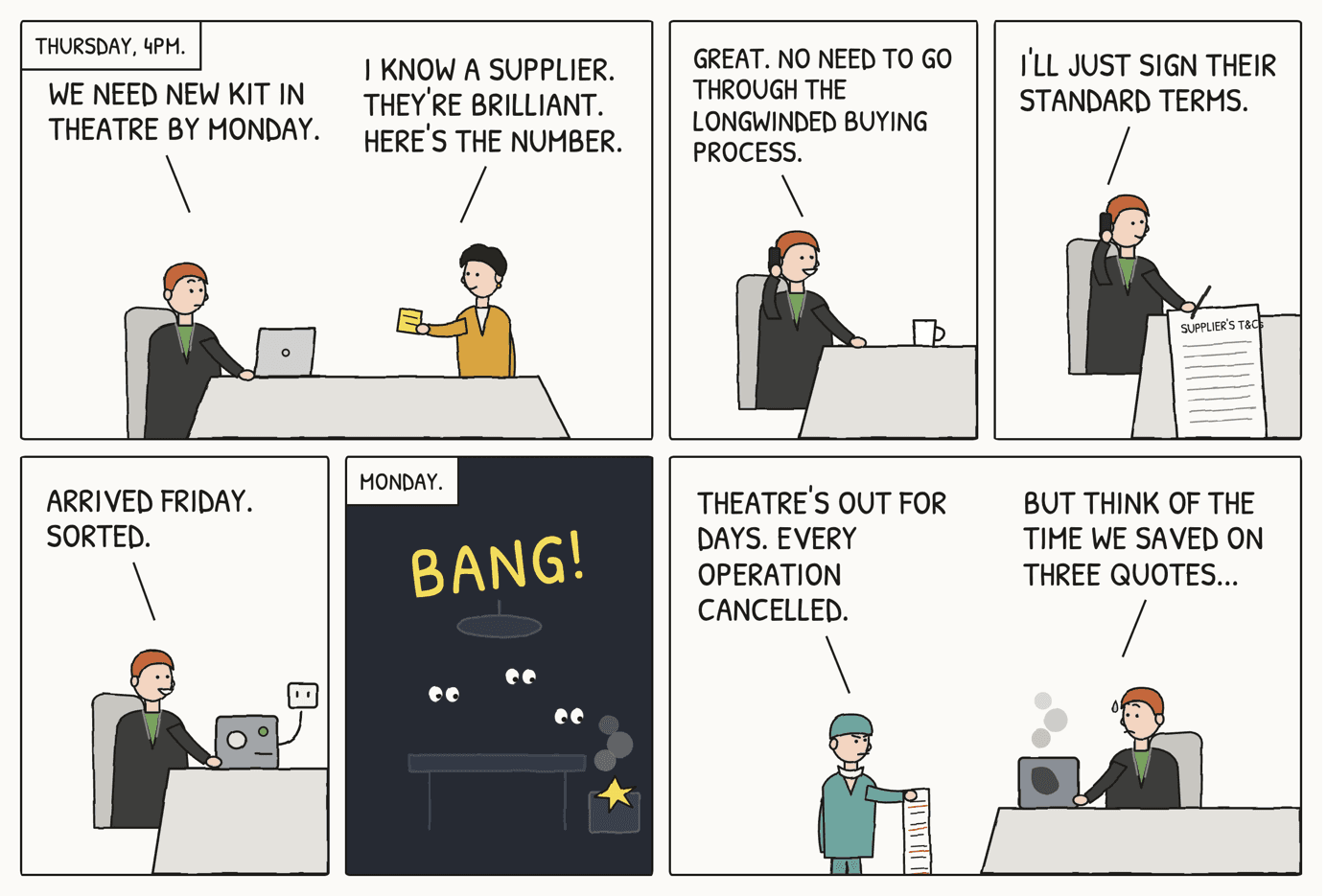
Take a simple example. It is Thursday afternoon and a piece of kit is needed for Monday. A colleague knows a supplier: “They’re brilliant, here’s the number.” A deal is done directly, the product arrives, and none of it has gone through the proper route.
Three things have now happened, none of them obvious at the time.
1. The buyer has accepted the supplier’s own terms and conditions, written to protect the supplier.
2. Nobody has checked that the product meets the standards it needs to. And if that piece of equipment is plugged in and blows the electrics, taking out an operating theatre or, at worst, harming a patient, the person who bypassed the process may find themselves personally exposed.
3. The shortcut saved the time it takes to raise three quotes. But the ripple it set off cost far more. It cost a theatre offline for days, a backlog of cancelled procedures, and a colleague carrying a liability they never signed up for.
Making the Message Stick
Very few people will read a fifty-page procurement manual, let alone the SFIs. It is procurement’s job to make governance digestible. Take a real example: “we’re buying gloves: how do we go about it?” and turn it into a one-page flowchart. Run short, interactive sessions rather than circulating a procedure document and waiting for comments. Share bite-size “did you know?” facts over time.
When the Procurement Act 2023 arrived, it came with a set of two-minute animated explainers. People still go back to them, because they are short, on demand and easy to remember. That is no accident. Stories are remembered up to 22 times better than facts alone, and the message people remember is the one they follow.
Bring People In Early
The most reliable way to make a rule stick is to bring people in before it
exists. A policy imposed from the top invites one question: how do I get around this? A policy someone helped write gives them ownership of it. A consignment stock policy owned jointly by procurement and the theatre teams who use it will be practical, and defended by the people who rely on it. Stakeholder engagement was the subject of an earlier Pragmatist. The lesson to remember here is about timing. Governance embeds when the timing and the ownership are right, and it fractures when procurement is only called in the week a contract is due to expire.
What Good Governance Protects
The stakes have risen. Under the Procurement Act 2023, suppliers have clearer routes to challenge an award decision, including the automatic suspension of a contract while a challenge is resolved. Pipeline, tender and contract award notices are all published on the Central Digital Platform, so every decision is visible to the suppliers and stakeholders whose trust procurement depends on. A well-governed decision keeps the service it supports running.
And when the process is bypassed, the scrutiny that follows is usually worse than the task itself. More questions. Tighter controls from finance and audit. A slower route for everyone next time.
It cuts both ways. A single tender waiver is not a dirty word. Waivers are provided for in the regulations and the SFIs for good reason, and pushing their use to zero simply sends people looking for another way round. Good governance means using the tools that exist, for the right reasons and in the open.
Speed You Can Defend
There is a stubborn belief that governance slows everything down. Done badly, it does. Done well, and understood by the people it applies to, it speeds decisions up, because everyone already knows the route, the thresholds and who signs off what.
It also brings consistency. Pick up a procurement document from anywhere in the organisation and you know it meets the standard, because the practice behind it is the same. Consistent practice means data you can trust, apples compared with apples.
That is what lets procurement walk into any conversation with confidence, build the relationship, hold its own and keep its seat at the table. And a seat at the table is far easier to keep than to win back.
If anything here resonates, or you have a governance challenge of your own you'd like to talk through, please get in touch.
Nicky Hay
, EcoVate Group